Blank canvas or template? A Framer Agents test
I ran the same hero brief twice, once on a blank Framer project, once on a finished template. Both looked good. What was underneath them wasn't remotely the same.
8
minutes read
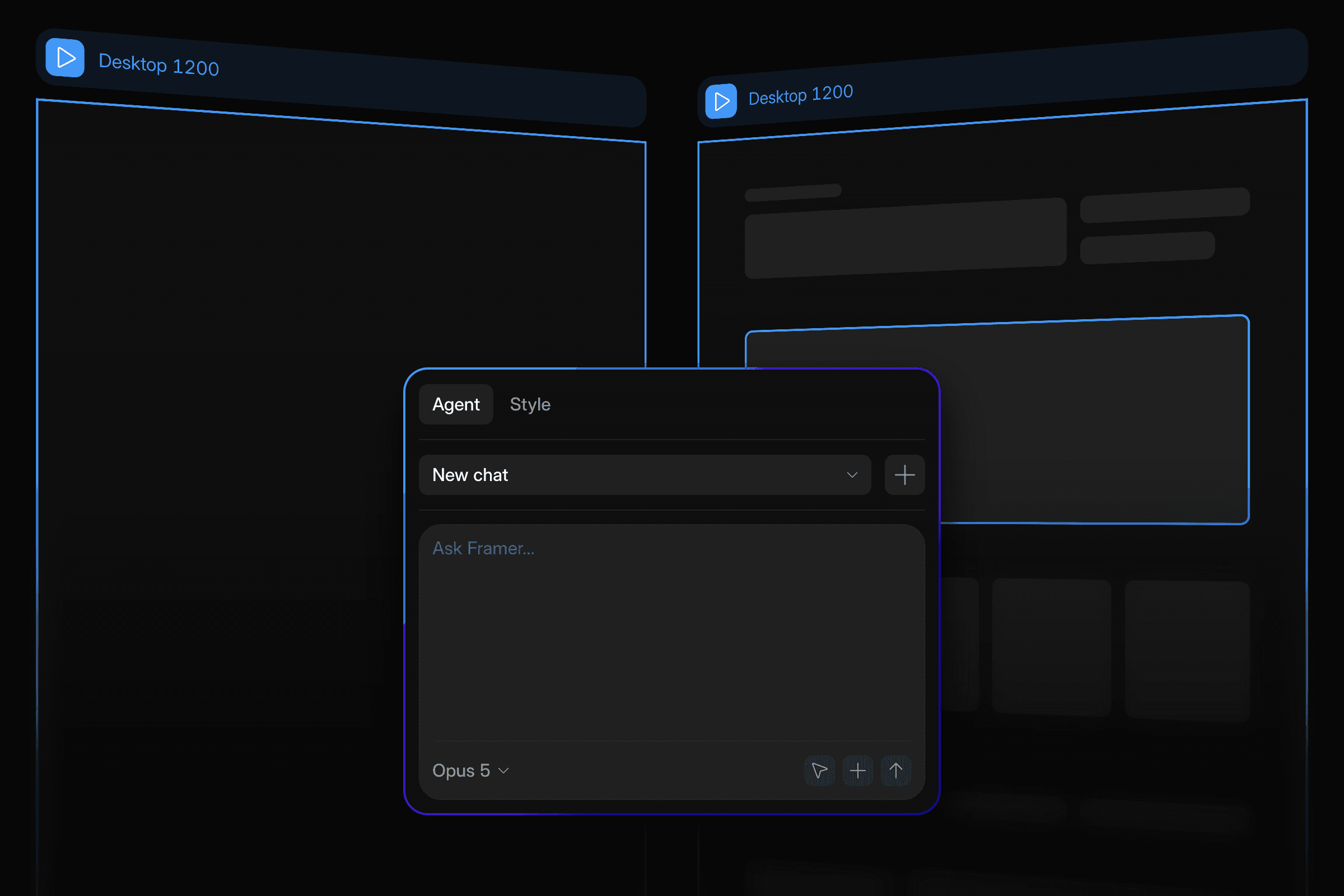
Agents build screens. Templates build systems.
Framer's agent is good enough now that the question is worth asking honestly: if you can describe a hero section and get a real one back, why start from a template at all?
So I tested it. Same model, same image, same content, one variable, what was already in the file.
Both results looked good. What sat underneath them didn't match at all.
The setup
Two Framer projects. One completely empty. One running Reelio, a dark editorial template built for photo and film studios.
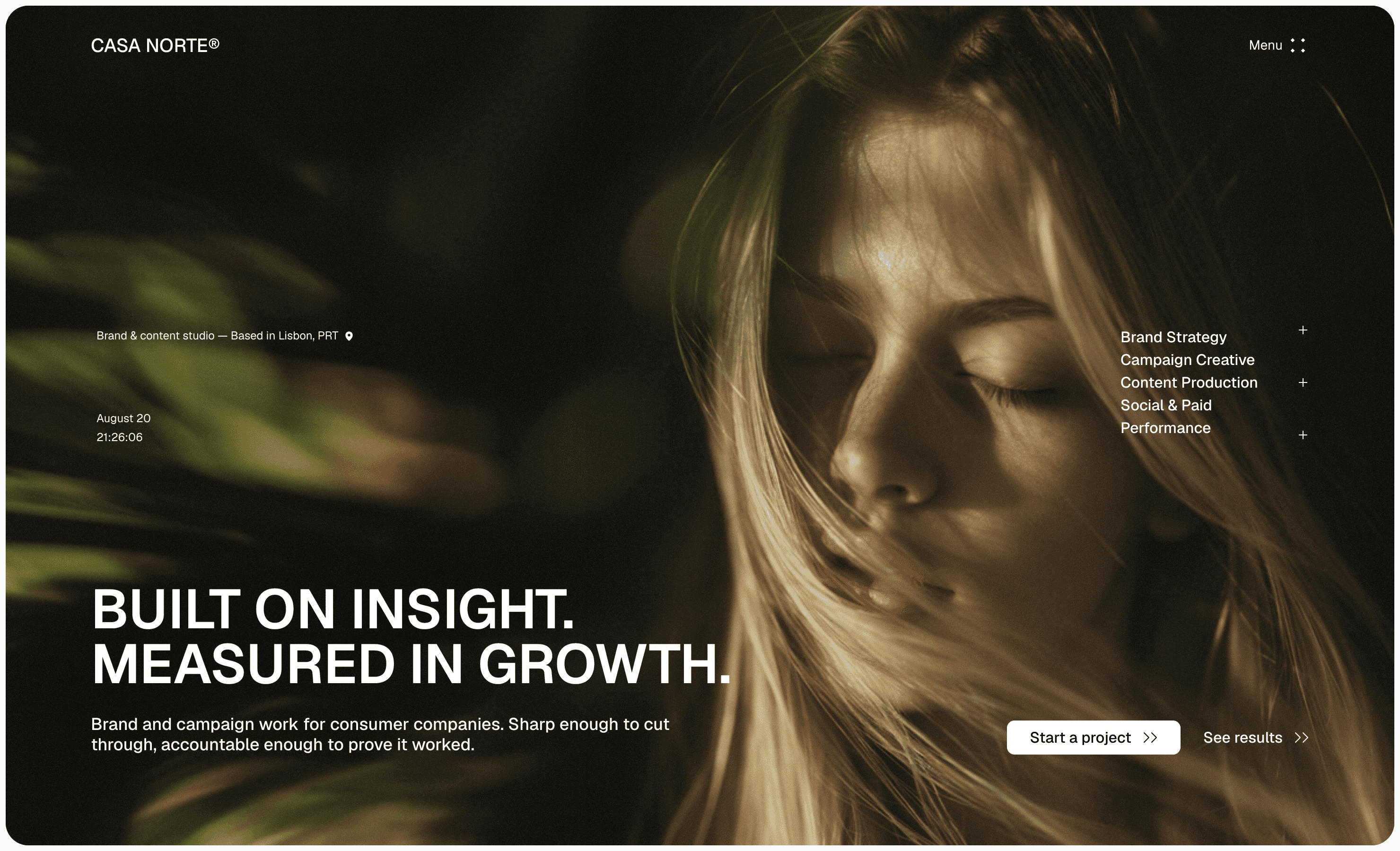
Both got the same brief: build a hero for CASA NORTE, a fictional brand and content studio in Lisbon. Same headline, same supporting line, same five services, same two CTAs, same background image.
Both ran on Opus 5, light reasoning. One prompt each, no follow-ups.
The only difference was operational, and it has to be. You can't tell an empty project to "keep the existing styles," and you can't tell a built one to "create a navbar" without ending up with two.
Blank canvas:
Use the attached image as the hero background. Create a dark editorial hero for CASA NORTE, a brand and content studio in Lisbon. Full-bleed image with text over it, wordmark "CASA NORTE®" top left and menu top right, a tagline reading "Brand & content studio — Based in Lisbon, PRT" with a location pin, a live date and time stamp, a service list on the right side with Brand Strategy, Campaign Creative, Content Production, Social & Paid and Performance, the headline "BUILT ON INSIGHT. MEASURED IN GROWTH.", a supporting line reading "Brand and campaign work for consumer companies. Sharp enough to cut through, accountable enough to prove it worked.", and two CTAs: "Start a project" and "See results".
Template:
Use the attached image as the hero background. Replace the text content in the hero, keeping all styles, layout and components exactly as they are. Wordmark becomes "CASA NORTE®", tagline becomes "Brand & content studio — Based in Lisbon, PRT", headline becomes "BUILT ON INSIGHT. MEASURED IN GROWTH.", supporting text becomes "Brand and campaign work for consumer companies. Sharp enough to cut through, accountable enough to prove it worked.", services become Brand Strategy, Campaign Creative, Content Production, Social & Paid and Performance, and the CTAs become "Start a project" and "See results".
Same content. One says create, the other says replace.
Both results were good
This is the part I want to be straight about, because it's where most posts like this quietly cheat.
The blank canvas produced a genuinely strong hero. Confident condensed headline running the full width, mono metadata block top left, hairline rules between the service items, clean CTA pair. If someone showed me it cold, I wouldn't guess it came out of an empty file in seventy seconds.

The template version looked different, stacked headline, its own type, plus icons on the service list, but no better and no worse. It was pulling the brand's existing decisions rather than inventing new ones.
Visually, it's a wash. If your standard is "does this look good," the agent alone clears it. That's not the interesting question anymore.
The number that went the wrong way
Blank canvas | Template | |
|---|---|---|
Credits used | 227 | 322 |
Total time | 1m 10s | 1m 3s |
Input tokens | 25,946 | 59,642 |
Output tokens | 4,646 | 2,450 |
Model | Opus 5 | Opus 5 |
The template run cost 42% more credits and consumed 2.3× the input tokens.
If your pitch is "templates save you money on AI," that table kills it. I'd been half-planning to write that post. The data said no.
But look at the last row, because that's where the actual finding is.
Reading a system costs more than ignoring one
The input number went up because the agent had to load the existing project before it could touch anything, components, styles, layout, breakpoints, the CMS. It read a system before editing it.
The blank canvas read almost nothing, because there was nothing to read.
That's a real cost, and it's worth naming honestly rather than hiding. But it's also mostly a fixed cost. It scales with the size of your project, not with how many pages you generate. Page twelve pays roughly the same reading tax as page two.
Now the output column. The blank canvas generated 4,646 tokens, nearly double the template's 2,450.
It wrote more because it was deciding more. Every one of those extra tokens is a choice the agent made on my behalf: a type scale I didn't specify, spacing I didn't ask for, a button treatment it picked. Some of those choices were great. None of them were mine, and none of them are recorded anywhere I can reuse.
The template spent its budget reading. The blank canvas spent its budget guessing.
Elements vs components
Here's what the credit panel doesn't show.
The blank canvas gave me a hero made of elements. Text layers. Frames. A navbar that looks like a navbar but is really a row of text nodes. A service list drawn as five separate items, you can see it in the screenshot, there are no expand affordances, because there's nothing to expand.
The template gave me the same visible hero made of components. A real nav component. Type bound to defined styles. A service list that opens. A timestamp that runs. Hover states that already work. Breakpoints already set.
To get from the first to the second, I'd have to build all of it, convert elements to components, define styles, wire up interactions. Manually, or with more prompts, which is more credits. That's a cost I simply haven't paid yet. It isn't in the 227.
The CMS difference
The sharpest version of this is the service list.
On the blank canvas, those five services are text sitting in layers. On the template, they're entries in a CMS collection.
Same words on screen. Completely different object underneath.
The collection version means one edit updates every instance across the site. It means the client can change a service name without opening Framer. It means adding a sixth service is a row, not a redesign. It means the content is queryable, filterable, and relatable to other collections.
None of that is available on the blank canvas until someone builds it. And migrating hardcoded text into a collection after the fact is exactly the kind of restructuring where an agent tends to break your layout on the way through.
Where this actually bites: page two
One hero proves very little. Both approaches produce one good screen.
The difference is what happens when you ask for the next one.
The template has something to be consistent with. Ask for an About section "in the same style" and there's a literal style to reference, defined, named, already applied.
The blank canvas has to re-derive its own decisions from a description. It doesn't remember why it chose that type scale, because it never chose it in a way that persists. You get a section that's nearly right and permanently slightly off, and every subsequent page compounds it.
That's the thing you're buying. Not pixels. Constraints.
What this test doesn't prove
A few honest limits:
One test, one section. Two runs, a single hero. Not a benchmark.
Agents can build components if you ask. Nothing here says they can't. The claim is about how many prompts, how many credits, and how consistently, not about capability.
The blank canvas result was genuinely good. If you need one landing page and nothing after it, you may not need a template at all. That's a real answer, not a concession.
Credit costs will move. These numbers are from August 2026 on Opus 5 with light reasoning. Treat them as a snapshot.
The takeaway
An agent on a blank canvas makes you a screen.
An agent on a well-built template makes you a page inside a system that already exists: components, styles, interactions, CMS, breakpoints, all of it decided before you typed anything.
The template run cost more. It also didn't have to invent a single thing.
If you're building one page, prompt away. If you're building a site, start from something structured and let the agent do what it's genuinely excellent at: filling a system in, rather than inventing one from scratch every time you ask.
The template used in this test is available here: Reelio.

Cristian Mielu
Founder UIHub.design
Share this page on:
Complete Templates collection
$1,286
$290
Best value
All Cristian Mielu's
12
premium templates.
Every new one included, forever.
Payments powered by
Other useful articles


Better Framer skills are a few reads away →